Contents
- Key dates for Diwali 2026
- How Diwali’s date is set
- Origin and meaning
- How Diwali is celebrated across regions
- Traditions and festive foods
- Greetings and messages to send
- Gift and decoration ideas
- Hosting a welcoming Diwali gathering
- Public holidays and travel notes
- Cultural sensitivity and one practical takeaway
Diwali 2026 falls on Sunday, 8 November, the main Lakshmi Puja night for much of India and the global diaspora. The Festival of Lights runs as a season rather than a single evening, with most calendars showing a five‑day arc from Dhanteras to Bhai Dooj and many families starting preparations well before the lamps are lit.
Key dates for Diwali 2026
Because Diwali follows the Hindu lunisolar calendar, its dates move each year on the Gregorian calendar. For 2026, many widely used panchangs give this outline, with a reminder that local almanacs can differ by a day:
- Dhanteras: Friday, 6 November 2026
- Naraka Chaturdashi / Choti Diwali: Saturday, 7 November 2026
- Diwali / Lakshmi Puja (main night): Sunday, 8 November 2026
The days after Diwali vary more between calendars:
- Govardhan Puja / Annakut: typically the day after Diwali, with major North Indian panchangs placing it early in the week of 9–10 November 2026, depending on location.
- Bhai Dooj: usually one or two days after Diwali; for 2026 many calendars place it around 10–11 November.
Regions outside India sometimes mark the public holiday on a different civil date, but if you are planning a gathering, Sunday 8 November is the anchor night most communities will recognise. For precise puja timings, check a trusted local panchang or temple closer to the festival.
How Diwali’s date is set
Diwali is tied to the new moon (amavasya) of the Hindu month of Kartika. The main celebration is held on the evening when the amavasya tithi is present during pradosh, the after‑sunset period when lamps are lit. Kartika’s new moon usually arrives between mid‑October and mid‑November.
Because lunar months are based on celestial calculations and interpreted slightly differently across regional calendars, the date can move by a day from one state or country to another. In 2026, most North Indian and many diaspora calendars align Lakshmi Puja with Sunday 8 November, while some South Indian communities emphasise Naraka Chaturdashi the day before as their central Deepavali.
Origin and meaning
Diwali, or Deepavali, literally means “row of lamps”. Across regions, it carries a cluster of stories and meanings rather than a single origin.
In much of North India, the Diwali night marks the return of Rama, Sita and Lakshmana to Ayodhya after fourteen years of exile and Rama’s victory over Ravana. People lit rows of lamps to guide them home, an image echoed today in homes lined with diyas.
In South India, the focus often falls on Naraka Chaturdashi and the story of Krishna’s defeat of the demon Narakasura. The traditional pre‑dawn oil bath, new clothes and noisy firecrackers reflect this victory theme.
In West Bengal and parts of eastern India, the same night becomes Kali Puja. Families and communities install clay idols of the goddess Kali, worship through the night and light fourteen lamps, called choddo prodeep, for ancestors.
Diwali also matters to other faiths. Sikhs observe Bandi Chhor Divas, remembering Guru Hargobind’s release from imprisonment, and many gurdwaras are illuminated. Jains mark the nirvana of Mahavira around the same time. In Nepal, a related festival called Tihar stretches the themes of light, gratitude and family bonds across five distinct days.
Across these traditions, the through‑line is clear: light over darkness, good over evil, and a sense of renewal at the start of a new financial or spiritual year.
Light a single lamp and you change the room; light many and you change the evening.
How Diwali is celebrated across regions
The festival looks and feels different from one region to another. A few concrete patterns help if you’re visiting or hosting.
North India (Delhi, Uttar Pradesh, Rajasthan and beyond)
Homes are thoroughly cleaned, doors and balconies are strung with marigold garlands and electric lights, and rangoli patterns appear at thresholds. On the main night, families perform Lakshmi–Ganesh puja, light diyas, share sweets and often burst firecrackers. In cities like Delhi and the wider National Capital Region, fireworks may be restricted in some years because of air‑quality concerns, so many households now focus on lamps and indoor gatherings.
Gujarat and western India
In Gujarat, Diwali dovetails with the Gujarati New Year (Bestu Varas). Traders hold Chopda Pujan, closing old ledgers and opening new account books with sandalwood and kumkum marks. Families exchange farsan (savory snacks) and sweets, and visit temples and relatives. In Maharashtra and Goa, large paper lanterns called akashkandil hang from windows, and doorstep rangoli is almost a signature of the season.
South India (Tamil Nadu, Karnataka, Andhra Pradesh, Kerala)
Deepavali morning often begins before dawn with abhyanga snan, a sesame‑oil bath followed by new clothes and breakfast sweets. Firecrackers are lit in the morning rather than late at night. Regional menus vary but you’ll commonly find murukku, adhirasam, badusha and rich payasam. In Karnataka, Bali Pratipada takes the place Govardhan Puja holds in North India.
East India (West Bengal, Odisha, Assam)
In West Bengal, Kali Puja dominates Diwali night, with decorated pandals, clay idols of Kali and specific offerings such as sandesh and narkel naru. Families light fourteen small clay lamps for ancestors. In Odisha, households call upon ancestors with burning jute sticks and modest fireworks.
Nepal and the wider diaspora
In Nepal, Tihar spans five days devoted in turn to crows, dogs, cows, Lakshmi and the bond between brothers and sisters (Bhai Tika). In Singapore, Malaysia, Fiji, Mauritius, Trinidad and parts of the Caribbean, a single public‑holiday day of Deepavali is surrounded by community events, public light‑ups and open houses. In the UK, US and Canada, large temple gatherings and city Diwali melas attract thousands, even though the festival is not a national public holiday.
Traditions and festive foods
Food and light sit at the heart of Diwali.
Lights and rangoli
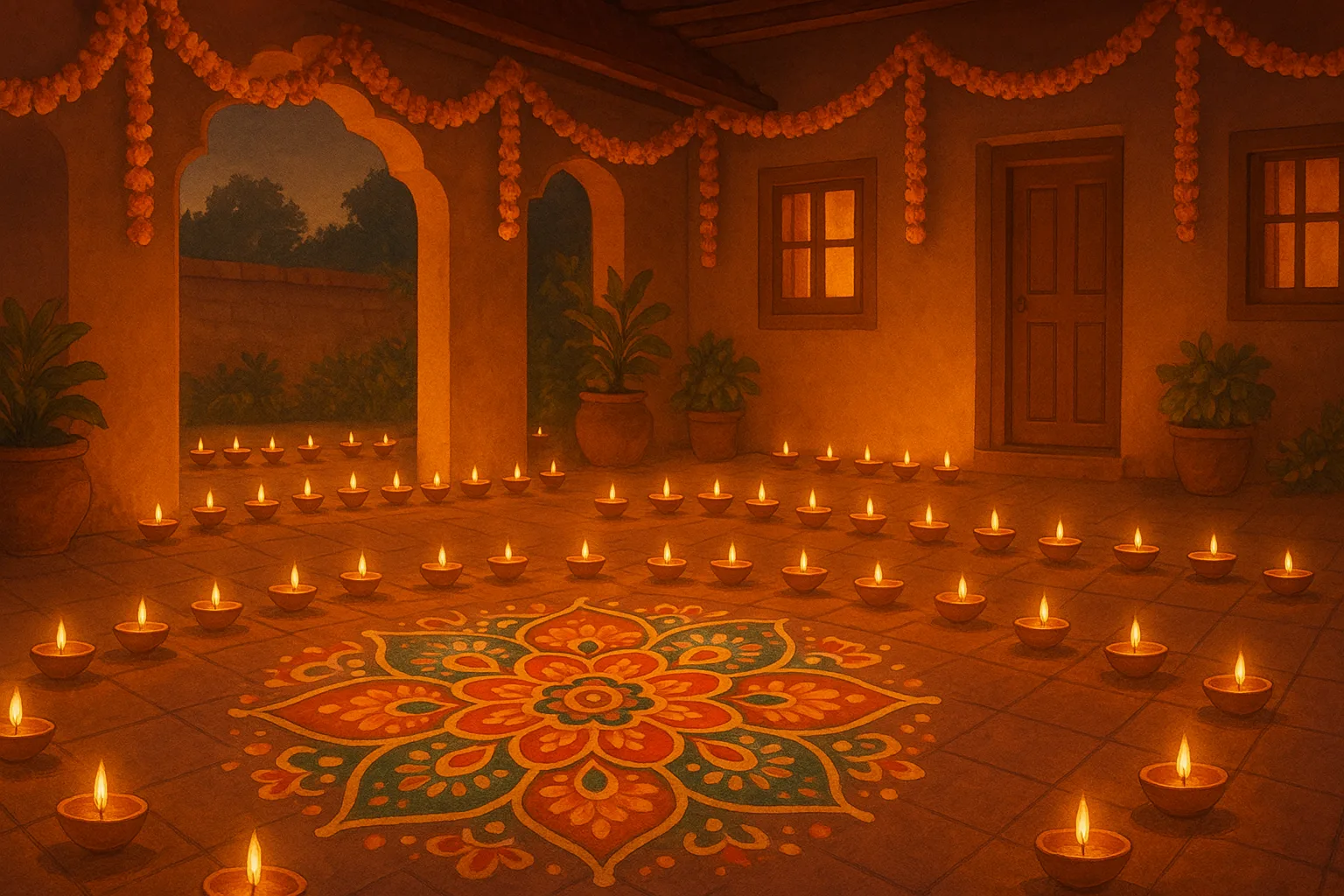
Small clay oil lamps (diyas) line windowsills, balconies and stairways. Many homes add coloured string lights or decorative lanterns (kandils, akashkandil) and draw rangoli patterns at the entrance using rice flour, coloured powders or flower petals. The idea is simple: create a visible welcome for Lakshmi and guests.
Sweets and savouries
In North Indian households you can expect gujiya, besan laddoo, kaju katli, barfi and often soan papdi passing from hand to hand on stainless‑steel trays. Bengali families make sandesh, payesh and coconut sweets like narkel naru for Kali Puja. South Indian kitchens turn out murukku, adhirasam, badusha and payasam, while Gujarati homes fry chakri and gathiya and prepare chevdo (a crisp savoury mix) alongside sweets such as mohanthal and sukhadi.
A typical puja thali might hold roli (red powder), rice grains, a diya, incense, flowers, sweets and a small coin, ready to be offered and then shared.
Greetings and messages to send
Most people will understand a simple “Happy Diwali”, and for many colleagues or neighbours that is enough. If you’d like to personalise a card or message, keep it short and warm:
- “Wishing you and your family a very Happy Diwali. May the year ahead bring light, health and prosperity.”
- “Shubh Deepavali! May the diyas glow with peace and the sweets with joy.”
- “Happy Diwali 2026 — hope your home is filled with laughter, light and too many laddoos.”
For Gujarati friends, “Saal Mubarak” is the traditional new‑year greeting the day after Diwali. For Nepali friends celebrating Tihar, “Subha Tihar” is a thoughtful touch.
Gift and decoration ideas
When you’re choosing gifts, classic and usable beats elaborate.
- A box of good‑quality mithai or assorted dry fruits
- Decorative diyas or a small brass puja plate and incense set
- Scented candles or simple lanterns
- A modest hamper with tea, biscuits and nuts for work contacts
If you’re gifting sweets, check whether the recipient keeps vegetarian or avoids eggs or gelatine.
At home, aim for a warm, layered look rather than a perfect showpiece. Line windows and steps with diyas or LED tealights. Place a toran of marigolds or artificial flowers above the door. A simple rangoli at the threshold — even a basic pattern traced in rice flour with a few petals — signals the festival as clearly as a complex design.
Hosting a welcoming Diwali gathering
If you’re hosting, design the evening around light, food and conversation.
Decor and layout
Buy diyas or tealights in bulk and cluster them in safe spots: trays on low tables, window ledges away from curtains, and along a balcony edge. Keep one corner of the main room as a puja space, with a small picture or idol of Lakshmi and Ganesha, a lamp, flowers and a plate of sweets. Leave a clear area for shoes near the entrance and a mix of chairs and floor cushions so older guests and children can both settle in.
Food plan
A relaxed menu works better than an ambitious one. You might:
- Start with vegetable samosas, pakoras or small kebabs
- Serve one or two mains such as chole or a paneer curry with jeera rice and rotis
- Finish with a selection of sweets — mithai from a local sweet shop is absolutely acceptable
Label dishes vegetarian, vegan or containing nuts, and keep a jug of water and soft drinks visible. A potluck, where each guest brings a favourite sweet or savoury, can take pressure off the host and introduce everyone to new recipes.
Fireworks and safety
If fireworks are permitted where you live, keep them short, early and supervised, and choose low‑noise options out of respect for neighbours, pets and elders. Many cities now encourage lamp‑based celebrations instead. Indoors, use LED tealights wherever a real flame might be knocked over, and keep matches and sparklers well out of reach of children.
The most common first‑time hosting mistake is trying to do everything: full‑length puja, elaborate rangoli, home‑fried sweets, fireworks and a seated dinner for a large group. Choose two or three core elements — a welcoming puja corner, reliable food and thoughtful lighting — and let the rest be optional.
Public holidays and travel notes
Diwali is a gazetted public holiday in India and is officially recognised in several other countries, including Nepal, Singapore, Malaysia, Fiji, Mauritius and Trinidad and Tobago. Banks, many government offices and schools close, and trains and buses are extremely busy in the days leading up to the main night.
In countries where Deepavali is an observance rather than a statutory holiday, such as the UK, Canada and much of the US, offices and schools often stay open while temples and community centres extend their hours for evening events.
If you’re travelling in or to India around Diwali 2026, book trains, flights and accommodation well in advance and expect markets and shopping districts to be at their busiest in the week before Dhanteras and Diwali.
Cultural sensitivity and one practical takeaway
Diwali rituals vary sharply between families and regions, even within the same city. If you’re hosting, tell guests ahead of time whether shoes will be removed for puja, whether the menu is strictly vegetarian and roughly when any formal prayers will take place. If you’re attending, a quick “Is there anything I should know before I come?” shows respect and prevents awkwardness.
If you remember only one practical guideline for Diwali 2026, make it this: set a clear puja start time around 7–8pm, focus on a small number of lamps, a simple rangoli and a plate of sweets, and let conversation and hospitality do the rest. That mix of light and welcome is what people carry with them long after the festival evening ends.