Contents
- Dates for upcoming years and how the date is set
- Origin and meaning
- Nightly rituals and the blessings
- How Hanukkah is celebrated around the world
- Traditions and festive foods
- Greetings and what to say
- Thoughtful gift ideas for all eight nights
- Decorations and hosting ideas
- Practical notes (work, school, travel)
- Planning Hanukkah 2026
- Frequently asked questions
Hanukkah 2026 begins at sundown on Friday 4 December and ends after nightfall on Saturday 12 December – eight nights starting on 25 Kislev in the Hebrew calendar. Here’s how the dates work, what to say when you light the candles, and classic foods and gift ideas for each night.
Dates for upcoming years and how the date is set
- 2025: sundown Sunday 14 December – nightfall Monday 22 December
- 2026: sundown Friday 4 December – nightfall Saturday 12 December
- 2027: sundown Friday 24 December – nightfall Saturday 1 January 2028
Hanukkah always begins on the evening of 25 Kislev. The Hebrew calendar follows lunar months but adds a leap month (Adar II) seven times in a 19‑year cycle to keep festivals in the same season. That lunisolar rhythm is why Hanukkah can land anywhere from late November to late December. Families often check a Hebrew calendar in autumn, because the evening on which the first candle is lit matters more in practice than the printed civil date.
In 2026, the first and last nights both fall on Fridays. On those evenings, Hanukkah candles are lit before Shabbat candles, and both are lit earlier than usual so that all kindling is completed before sundown.
Origin and meaning
Hanukkah (often also spelled Chanukah, meaning "dedication") marks the rededication of the Second Temple in Jerusalem after the Maccabean revolt in the 2nd century BCE. According to the Talmud, the community found only a single sealed jar of pure olive oil – enough to keep the Temple menorah burning for one day – yet the flames lasted for eight days while new oil was prepared.
That story is why light and oil sit at the heart of the festival. Hanukkah celebrates the restoration of the Temple’s light, religious freedom after foreign rule, and the idea that a small flame, tended carefully, can push back a great deal of darkness.
Nightly rituals and the blessings
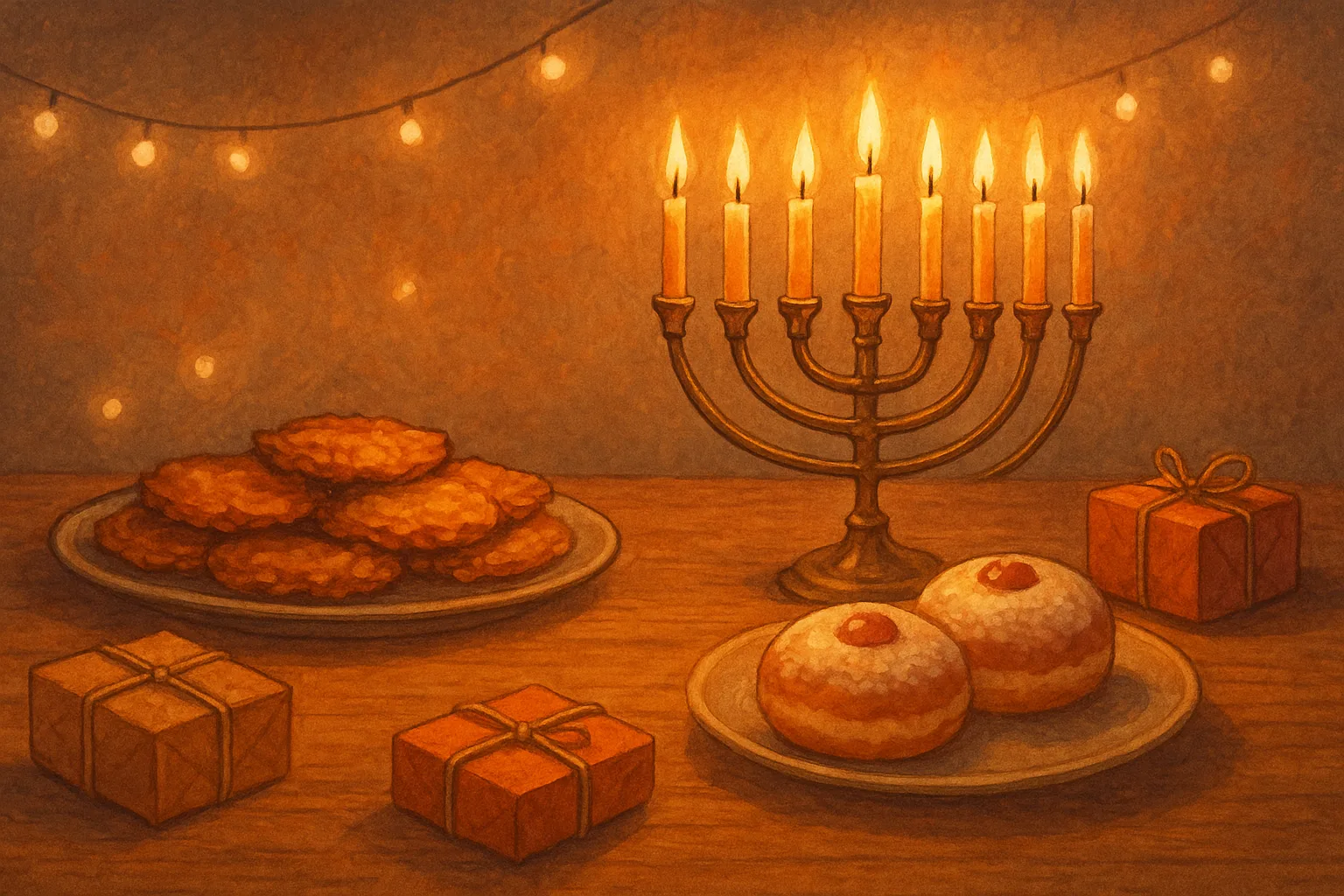
The central home ritual is lighting the hanukkiah, a nine‑branched menorah used especially for Hanukkah. Eight branches mark the nights; the ninth, the shamash or "helper" candle, is set apart or higher and is used to light the others.
Practical lighting guidelines:
- Place the hanukkiah where its light can be seen, such as a street‑facing windowsill or a prominent table. Publicising the miracle is part of the tradition.
- Insert candles from right to left, following Hebrew reading order, but light them from left to right so the newest candle is lit first.
- Let the candles burn for at least 30 minutes after nightfall. Oil lamps are also used in some households, especially where there is a long‑standing family custom.
- On Friday nights of Hanukkah, light the Hanukkah candles before the Shabbat candles and earlier than usual, then avoid handling the hanukkiah during Shabbat.
Three blessings are recited on the first night and two on the remaining nights.
- Blessing over the lights (all nights): "Baruch atah Adonai, Eloheinu Melech ha’olam, asher kid’shanu b’mitzvotav v’tzivanu l’hadlik ner shel Hanukkah."
Blessed are You … who has sanctified us with commandments and commanded us to kindle the Hanukkah light.
- Blessing for the miracles (all nights): "Baruch atah Adonai, Eloheinu Melech ha’olam, she’asah nisim la’avoteinu bayamim haheim bazman hazeh."
… who performed miracles for our ancestors in those days, at this season.
- Shehecheyanu (first night only): "Baruch atah Adonai, Eloheinu Melech ha’olam, shehecheyanu v’kiyimanu v’higianu lazman hazeh."
… who has kept us alive, sustained us and brought us to this season.
After the blessings, many families sing "Ma’oz Tzur" or "Hanerot Halalu", and some join synagogue or community lightings that include psalms and songs.
Add one candle each night and give the hanukkiah pride of place where its glow can be seen from outside – Hanukkah is both an intimate home ritual and a public festival of light.
How Hanukkah is celebrated around the world
In Israel, large public menorahs appear in city squares, malls and outside municipal buildings. Schools usually close for a Hanukkah break, bakeries produce vast numbers of sufganiyot (jam‑filled doughnuts), and there are nightly events ranging from small street concerts to major community gatherings.
In the United States, Canada, the UK and other diaspora communities, Hanukkah is mostly a home‑and‑synagogue festival. Families light a hanukkiah, attend family services, and join public lightings in parks or outside communal buildings. In cities with larger Jewish populations, it is common to see menorah parades and charity drives tied to the eight nights.
Sephardi and Mizrahi communities weave in regional flavours. Moroccan families may serve bimuelos (honey‑soaked fritters), Syrian kitchens prepare sufganiyot scented with rosewater or stuffed with date paste, and distinctive Hebrew and Judeo‑Arabic melodies shape synagogue services. Across Latin America, Eastern Europe and elsewhere, local music and menus change, but the core nightly lighting, blessings and dreidel game are recognisable almost everywhere.
Traditions and festive foods
Fried food is central because of the oil miracle.
- Latkes: grated potato pancakes fried in oil and served with applesauce or sour cream, with variations that use sweet potato, zucchini or root vegetables.
- Sufganiyot: jam‑ or custard‑filled doughnuts, especially associated with Israel, where bakeries offer creative fillings throughout the holiday.
- Other fried treats: bimuelos, croquettes and savoury fritters continue the oil theme, particularly in Sephardi and Mizrahi kitchens.
- Dairy dishes: some families serve cheese‑based dishes, linked to the story of Judith, who fed a rich dairy meal to an enemy general before defeating him.
Typical main courses for larger meals include brisket, roasted vegetables and kugel, often served family‑style so guests can linger around the table after the candles are lit.
The dreidel game is another familiar tradition. Each side of the spinning top carries a Hebrew letter – nun, gimel, hei and shin outside Israel, where they stand for "a great miracle happened there"; in Israel shin is often replaced by pe, for "a great miracle happened here". Players use tokens such as chocolate coins (gelt), nuts or small sweets, which keeps the game simple to teach children.
Gelt originally referred to real coins given to children as a reward for study and good behaviour. Many families still give a modest amount of money for saving or charity and pair it with chocolate coins for fun.
If you enjoy learning about other festivals of light as well, our Diwali 2026 guide explores how the Hindu festival in autumn is celebrated and how hosts plan their gatherings.
Greetings and what to say
Short greetings are widely understood:
- "Happy Hanukkah" works in any setting.
- "Chag Urim Sameach" means "joyous festival of lights" in Hebrew.
A few message ideas for cards, texts or emails:
- "Wishing you a peaceful Hanukkah filled with light, laughter and latkes."
- "May each night of Hanukkah bring more warmth and joy into your home."
- For colleagues: "Warm Hanukkah wishes – may the lights of the season bring you rest and renewal."
Tailor the wording to the relationship and keep the focus on light, peace and family.
Thoughtful gift ideas for all eight nights
Gift‑giving during Hanukkah has grown in recent generations, partly because the festival falls near Christmas in many countries. The most sustainable pattern is either one meaningful gift given on the first or last night, or a series of small, thoughtful tokens across the eight nights.
Ideas by recipient:
- Children: age‑appropriate storybooks with Jewish characters or history, a sturdy wooden or ceramic dreidel, art supplies, or a tzedakah box with a few coins to start a giving habit.
- Teens and young adults: a cookbook of modern Jewish recipes, a favourite board game for post‑lighting evenings, or a streaming‑service gift card for movie nights.
- Partners and parents: a well‑made hanukkiah or artisan candle set, a framed family photo, or tickets to a concert, play or museum.
- Hosts and neighbours: a bottle of good olive oil, a box of fresh sufganiyot from a local bakery, or a donation to a charity they care about made in their name.
Keeping gifts modest helps the candles stay at the centre of the celebration. Many experienced hosts avoid turning Hanukkah into a competition of presents and instead pair each night’s candle lighting with one small gesture – a note of appreciation, a shared dessert, or an agreed act of tzedakah.
Decorations and hosting ideas
Hanukkah lends itself to simple, warm decor rather than elaborate staging.
- Menorah focus: choose a windowsill or entry table where the hanukkiah is safe and visible, then build the rest of the room around that focal point.
- Latke bar: set out toppings such as applesauce, sour cream, chopped chives, smoked salmon or pickles so guests can customise plates.
- Dreidel corner: keep a bowl of dreidels, chocolate gelt and a printed sheet of rules so children and adults can start games without needing instruction every time.
- Safety: place drip catchers under candles, keep flammable objects away from the flames, and consider an electric menorah as a decorative backup in homes with young children or pets.
For a larger Hanukkah gathering, many hosts find one main evening during the eight nights works best, with quieter family lightings on the other nights.
Practical notes (work, school, travel)
Hanukkah is not a public holiday in most countries, including the United States, Canada and the United Kingdom, so schools and workplaces generally remain open. In Israel, schools close for Hanukkah and many workplaces adjust schedules or organise events around evening lightings.
If you manage a team or classroom, it is considerate to avoid scheduling major deadlines or evening events on the first and last nights, when many families prioritise being at home for candles and meals. Flexible hours or options for remote participation can make a significant difference for observant staff.
Travel planning benefits from looking at the entire 4–12 December span. If you are visiting relatives, booking transport and accommodation early helps you avoid the busiest winter‑holiday weekends. For readers juggling multiple celebrations, planning menus and shopping for Hanukkah in advance frees up time later in the month for other seasonal gatherings.
Planning Hanukkah 2026
The simplest way to anchor Hanukkah 2026 is to mark Friday 4 December and Saturday 12 December on your calendar, then decide now what rhythm you want across the eight nights. Choose one main recipe, one shared activity and one charitable focus, and let those repeat with small variations.
With the dates fixed, blessings printed or saved, and a rough plan for food and gifts in place, the week tends to unfold calmly. Eight modest, intentional evenings – rather than one big blow‑out – are what give Hanukkah its distinct feeling of sustained light.
Frequently asked questions
How many candles are on a Hanukkah menorah and why?
A hanukkiah has nine branches: eight for each night of Hanukkah and one shamash or "helper" candle used to kindle the others. The extra branch ensures the Hanukkah lights themselves are not used for ordinary tasks such as reading or eating.
Can I use only an electric menorah for Hanukkah?
Electric menorahs are widely used for decoration or where open flames are unsafe, but traditional practice uses real candles or oil lamps for the actual mitzvah of lighting. Many families display an electric menorah in a window and light a smaller candle hanukkiah on a stable indoor surface.
Is Hanukkah considered a major holiday in Jewish law?
Hanukkah is widely observed and rich in custom, but it is classified as a post‑biblical festival rather than a major pilgrimage holiday like Passover or Sukkot. Work is permitted, and the focus is on home ritual, learning and publicising the miracle.
What if I miss a night of candle lighting?
If you miss a night, simply resume lighting on the next evening with the correct number of candles for that night. There is no practice of "making up" missed nights; the goal is to join the ongoing sequence as best you can.
Do I need a kosher‑certified hanukkiah or candles?
There is no formal requirement for a certified product as long as the hanukkiah has space for eight equal lights plus a separate shamash and the candles or oil can burn for the required time. Many people choose sturdy, heat‑safe materials and good‑quality candles so the ritual runs smoothly.